





Nudism: definition, origins, values and practices in France
Let’s define nudism

Discovering nudism means, above all, understanding a natural, simple and caring practice, which often fits into the same philosophy as naturism. Far from the clichés, it is a way of life or an occasional experience in which one chooses to undress in suitable places, out of respect for oneself, for others and for the environment. Before taking the plunge or expressing curiosity, it is essential to know what the term nudism really covers: its definition, its values and its differences from other similar practices.
Key takeaways
To know what nudism really is
Nudism consists of practising nudity, alone or with others, in suitable places, without any sexual dimension or exhibitionism.
The word comes from the Latin nudus, “nude”, and since the early 20th century has referred to movements advocating nudity in the open air.
Nudity is simply a state, whereas nudism implies an intention, a suitable place and shared rules.
Naturism includes nudism, but adds an overall philosophy to it: respect for others, harmony with nature and ecological commitment.
Open to beginners, couples and families, it encourages self-acceptance and simpler interactions.
What is nudism? A simple and accessible definition
Nudism refers to the fact of practising nudity, individually or collectively, in suitable and supervised spaces. According to the definition of nudism, it is a natural, caring and respectful approach, which aims to feel free in one’s body, without any sexual dimension or search for exhibitionism. Nudism can be occasional, discovered during a stay, or become a genuine way of life geared towards well-being, simplicity and authenticity.
The origin of the word “nudism”
The word nudism comes from the Latin nudus, meaning “nude”. The term appeared in Europe at the beginning of the 20th century to describe movements advocating nudity in natural environments, often associated with sporting, hygienist and health practices. Nudism was then seen as a way of reconnecting with the body, with nature and with a simpler way of life.
Nudism vs nudity: what’s the difference?
Nudity is a physical state: being without clothes, in private, out of necessity, for comfort or in cultural contexts.
Nudism, on the other hand, corresponds to a supervised and considered practice; according to the definition of nudism, it is based on precise values, authorised places and rules of conduct. In other words, one can be nude without being a nudist, but nudism implies an intention, a suitable environment and shared principles.
What is the distinction between nudism and naturism?
Although close, the two notions are not entirely synonymous. Nudism focuses mainly on the practice of nudity within a social or leisure setting. Naturism, on the other hand, goes further: it incorporates an overall philosophy of life, combining nudity, respect for others, harmony with nature, well-being and often an ecological commitment. Naturism therefore includes nudism, but adds environmental, social and ethical dimensions to it.
The values associated with nudism
Nudism, whose definition is based on a natural and respectful practice of nudity, relies on a set of simple and positive values, geared towards respect, personal freedom and openness to others. Here are the main pillars of this practice:
- Respect for oneself and for others: nudism encourages a more serene relationship with one’s body, without judgement or comparison. Everyone is welcomed as they are, without physical or aesthetic criteria.
- Bodily freedom and simplicity: freeing oneself from clothes creates a feeling of authenticity and comfort. It is a way of returning to the essentials, far from social codes and dress constraints.
- Kindness and tolerance: nudist spaces operate on rules of mutual respect, which aim to guarantee a peaceful, non-voyeuristic environment.
- Harmony with nature: often practised outdoors, nudism develops a feeling of deep connection with the natural elements, encouraging relaxation, breathing and mindfulness.
Authenticity and equality: without visible social markers (brands, style, status), everyone presents themselves as they are, which encourages simpler, more sincere and more human exchanges.
Fancy giving it a try?
Discover nudity with complete peace of mind at one of the six France 4 Naturisme naturist campsites.
Discover our campsites
Who is nudism for?
Nudism, according to its definition, is aimed at anyone wishing to experience nudity in a respectful, calm and safe setting, whether they are beginners or regulars:
- People seeking bodily freedom: those who wish to feel good in their body and enjoy a moment without constraints.
- Couples or friends: to share a simple, authentic experience free of judgement.
- Families: some places are suitable for children and encourage an upbringing based on respect and kindness.
- The curious wishing to discover it gently: a practice accessible at one’s own pace, without obligation or pressure.
Advice from the France 4 Naturisme team: if you are a beginner, start with a short stay in a dedicated place, such as a naturist campsite, rather than on an isolated beach where the rules are less clear. There you will find rules known to everyone and a respectful atmosphere that make the first steps easier, at your own pace and without pressure.
The benefits of nudism
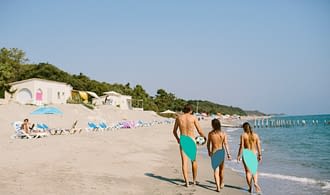
Practised in a suitable and supervised setting, nudism offers many advantages on the physical, mental and social levels. According to the definition of nudism, this natural practice makes it possible to move about without clothes in order to fully enjoy direct contact with the air, the light and the elements. The body feels freer and movements are more fluid, which provides an immediate sensation of comfort and well-being.
On the psychological level, nudism gradually helps to improve self-acceptance by moving away from aesthetic norms. It encourages letting go, helps to put insecurities into perspective and brings genuine mental relaxation. The practice makes it possible to refocus on essential values such as simplicity, confidence and serenity.
On the social level, nudism encourages more authentic interactions. Without markers linked to status or appearance, everyone is considered on an equal footing, making exchanges easier in a climate of mutual respect and kindness.
Nudism is above all a natural, respectful and accessible practice, which makes it possible to reconnect with oneself and one’s environment in a serene and caring setting. As the definition of nudism reminds us, it is not only about being nude, but about living an experience based on freedom, authenticity and acceptance. Discovered occasionally or lived as a genuine way of life, nudism invites us to slow down, to breathe and to enjoy the essentials. To go further, the ideal is to choose suitable, supervised and respectful places, in order to live this experience in the best conditions, such as our France 4 Naturisme campsites.
FAQ: nudism
-
What is the difference between a nudist and a naturist?
The nudist practises nudity; the naturist adds a philosophy of life to it. According to the definition of the International Naturist Federation adopted by the FFN (French Naturist Federation), naturism is a way of living in harmony with nature, through communal nudity, which encourages respect for oneself, for others and for the environment.
-
Is nudism legal in France?
Yes, in the places provided for this purpose: officially naturist beaches, naturist centres and campsites. Outside these spaces, nudity visible to the public may be penalised as indecent exposure. Before undressing, check that the place is clearly reserved for naturism.
-
Is nudism linked to sexuality?
No. Nudism, like naturism, is based on non-sexualised nudity, experienced with respect for everyone. Dedicated places apply strict rules of conduct against voyeurism and exhibitionism. It is this framework that allows families, couples and people on their own to feel confident there.
-
Can you practise nudism as a family?
Yes, many naturist places welcome families. Children grow up there with a simple and respectful image of the body, free of taboos or judgement. For a family holiday, preferably choose a child-friendly naturist campsite, with clear rules and a caring atmosphere.
Sources and references
- Fédération française de naturisme (FFN, French Naturist Federation), “Dossier de presse 2025” (2025 press kit: definition of naturism and Ipsos survey), FFN, 2025. View source
- Fédération des espaces naturistes (Federation of Naturist Spaces), “Qu’est-ce que le naturisme ? Définition, valeurs et pratique” (What is naturism? Definition, values and practice), naturisme.fr, 2026. View source
- Légifrance, “Article 222-32 du Code pénal (exhibition sexuelle)” (Article 222-32 of the French Criminal Code, indecent exposure), Code pénal, version in force since 2021. View source
Enjoy the benefits of naturism
and availabilities
Our campsites


