



Naturist meditation
Nude meditations: the essence of naturism for genuine well-being

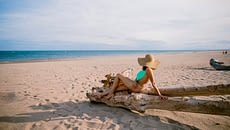
Would you like to discover nude meditation in a soothing, free environment close to nature? Our naturist campsites provide an ideal setting to gently take up this singular and deeply liberating practice.
Key takeaways
To get started with nude meditation
Nude meditation is practised without clothes, in a spirit of self-acceptance, far from any provocation or sexualisation.
Without fabric, sensations become finer (air, sun, ground), which helps you anchor yourself in the present moment.
It invites you to look at your body without filter or judgement and encourages letting go.
In a group, at a naturist campsite, it is based on consent, discretion and respect for personal space.
The cross-legged, lotus, lying or standing postures can be adapted, with a mat, a cushion or a natural fabric for comfort.

Understanding nude meditation and its unique benefits
Nude meditation, as its name suggests, is a meditation practice carried out in nudity, in a spirit of self-acceptance and deep connection with nature and the present moment. Far from any provocation or sexualisation, it is part of an authentic approach, often linked to the naturist way of life, where the body is seen as it is: natural, free and freed from all artifice.
This form of meditation draws its strength from simplicity. By shedding their clothes, meditators symbolically free themselves from social constraints, external judgements, and even their own mental conditioning linked to appearance. All that remains is the essential: oneself, here and now.
A deep reconnection with oneself
Practising nude meditation fosters a heightened bodily awareness. Without fabric to isolate us from our environment, sensations become finer: the contact of the air on the skin, the warmth of the sun, the coolness of the shade, the texture of the ground. This allows a powerful anchoring in the present, a return to an instinctive form of mindfulness.
This voluntary nudity also invites a better acceptance of one’s body image. By meditating nude, you learn to see your body without filter or judgement, to love it as it is. It is an act of reconciliation, a path towards greater kindness towards oneself.
Unique benefits for well-being
The benefits people feel from nude meditation are manifold. On a psychological level, meditation can help you manage stress better and calm your thoughts, and many naturists find greater self-acceptance through it. Nudity acts here as a catalyst for letting go: you stop “playing a role” in order to simply be.
On a physical level, many practitioners describe a feeling of relaxation and lightness, particularly in approaches inspired by yoga or naturist qi gong.
Finally, meditating nude can also strengthen the feeling of freedom, of inner peace and of coherence between one’s body, one’s mind and one’s way of life. It is a way of returning to the very essence of meditation: a direct, sincere and deeply human experience.
Fancy giving it a try?
Discover the wellness areas of the France 4 Naturisme campsites to continue your practice in a soothing setting.
Discover wellness


Practising nude meditation in a naturist setting
Nude meditation takes on its full meaning when it is practised in a respectful and caring environment, such as our naturist campsites. Indeed, naturism is not only a way of being nude: it is a philosophy of life based on respect for oneself, for others and for nature. In our naturist campsites, nudity is experienced as a form of authenticity and freedom.
The collective dimension: meditating nude together
Practising nude meditation as a group, in one of our naturist campsites, can intensify the experience. This collective practice reinforces the sense of belonging, of unity and of respect between participants. Of course, consent, discretion and respect for personal space are the pillars of these shared sessions.
A return to the essentials
In a society saturated with stimuli, social codes and appearances, practising nude meditation in one of our naturist campsites represents a true return to the essentials. It is an act of voluntary shedding, a step towards simplicity and authenticity. Therein lies all the power of this approach: reconnecting with one’s deep nature, in all humility, within an environment that fully welcomes the human being in their most natural state.

Meditation techniques and postures suited to nudity
Nude meditation, although inspired by traditional forms of meditation, requires a few adjustments to guarantee comfort, well-being and respect for the body. Practising without clothing alters sensations, postural ease and the relationship you have with the space around you. It is an opportunity to adopt techniques and postures that foster both grounding and relaxation in this embraced nudity.
- The cross-legged posture (Sukhasana): seated with legs crossed, back straight, hands resting on the knees or in the lap. Ideal for beginners.
- The half-lotus or lotus posture (Ardha Padmasana / Padmasana): more advanced, it allows a deep grounding but requires flexibility.
- The lying posture (Savasana): perfect for guided meditations or deep relaxation, particularly outdoors, in direct contact with the ground or grass.
- The standing position (Tadasana or mountain posture): ideal for meditations in movement or to feel the balance of the nude body facing the elements.
The key is to listen to your body.
Without clothing, certain sensitive areas may require support: a natural fabric, a cushion or a mat can be used for greater comfort, while keeping the spirit of nudity.
Reconnect with the essentials. Discover nude meditation and treat yourself to a real moment of well-being by booking your stay at one of our naturist campsites.
Advice from the France 4 Naturisme team: for your first sessions, start with the cross-legged posture or the lying posture, on a mat or a natural fabric. Choose a quiet, shady spot on the campsite, close your eyes and first focus on the feeling of the air on your skin. Ten minutes is enough to begin with; you can lengthen the sessions at your own pace.
FAQ: nude meditation
What is nude meditation?
It is meditation practised without clothes, in a spirit of self-acceptance and connection with nature and the present moment. There is nothing provocative or sexual about it: it is part of the naturist philosophy, where the body is seen as it is, natural and free, without artifice or judgement.
Can you meditate nude as a beginner?
Yes, nude meditation is accessible to beginners. The cross-legged posture, seated with legs crossed and back straight, is ideal to start with, as is the lying posture for guided meditations. A cushion, a mat or a natural fabric provides comfort for sensitive areas, without betraying the spirit of nudity.
Where can you practise nude meditation with complete peace of mind?
The simplest option is to meditate at a naturist campsite, where nudity is accepted and experienced as a form of authenticity. You will find a respectful setting, close to nature, and you can meditate alone or in a group. Outside these places, public nudity remains regulated by law.
Meditating nude in a group: how does it work?
Group sessions are based on simple rules: consent, discretion and respect for everyone’s personal space. Each person meditates at their own pace, without staring or judgement. Many participants find that shared practice strengthens the sense of belonging and mutual respect within the group.
Sources and references
- CNRS Le journal, “La méditation agit directement sur notre stress” (Meditation acts directly on our stress), interview with Antoine Lutz (Inserm), 2020. View the source
Enjoy a meditative holiday
and availabilities


